(The Lineage You Never See in a Nativity Scene)
You can listen to this article here:
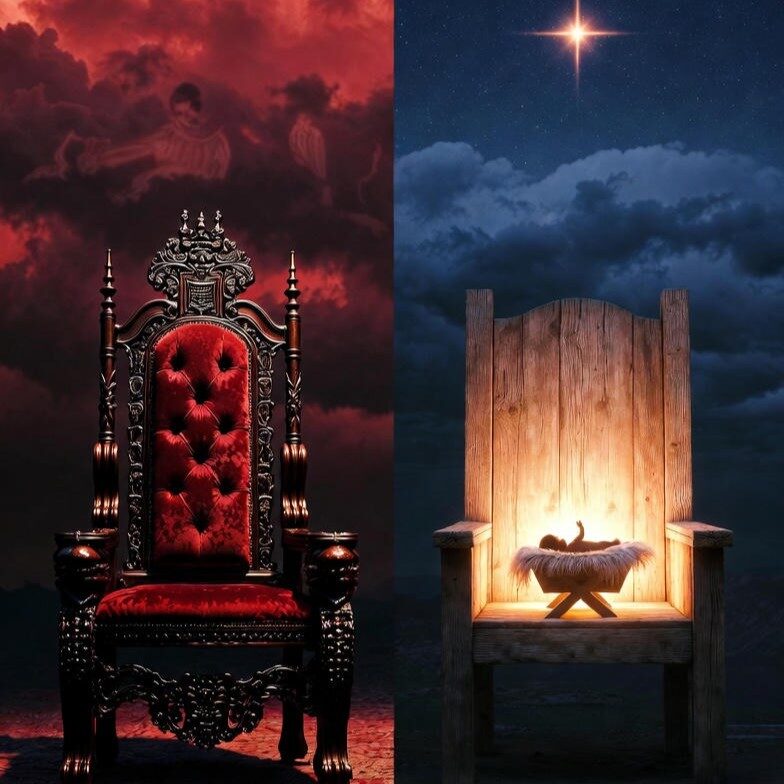
Have you ever seen King Herod depicted in a nativity scene? I’ve lived a long time, but I’ve never seen it. Not once.
Stars and angels and holy family and peaceful animals and joyful shepherds and adoring wise men, yes. But not Herod.
I’ve been pondering, though, the part that Herod played in the Christmas story.
I wrote about Herod before, here. But recently I’ve been thinking about the Christmas story from the perspective of Herod’s fascinating lineage.
Yes, not the lineage of Jesus. The lineage of Herod.
King Herod “the Great” was not a Jew but an Idumean, an Edomite. He was placed on the throne not because he inherited it or deserved it, but because Rome found him useful. He ruled for them. That was his qualification.
Everyone in Israel knew someone from the line of David should be on the throne. Herod didn’t belong. He had already murdered several rivals who had a greater claim to the throne than he did (which, to belabor the point, was none). Beneath his lust for power was surely a deep-seated fear.
When travelers showed up talking about a baby born “King of the Jews,” something stirred in him. It wasn’t wonder, but panic.
As far too many of my readers know, in people like Herod, panic can turn into control and rage, and control and rage can harden into unthinkable cruelty.
That’s how the infamous order went out, the one that still breaks our hearts. Soldiers sent to Bethlehem—to tear Jewish babies from their parents. A page of Scripture so dark it hurts to hold it.
But that darkness didn’t appear out of nowhere. It had a long, tangled trail behind it.
This is what I’ve been pondering.
Centuries earlier, two boys fought in their mother’s womb. Esau burst out first, strong and red and wild. Jacob followed after, holding on as if he already sensed what was going to happen.
The rivalry between the two men seemed to be resolved before they died, but it was never really resolved.
God had told their mother, “Two nations are in your womb,” and that’s exactly how it played out. Esau became the nation of Edom. Jacob became the nation of Israel.
God had assigned the nation of Edom the worthy, honorable job of serving the nation of Israel. But the Edomites did everything they could to reject that assignment. They became notorious for refusing to help Israel in the wilderness. Through the centuries, when Israel needed help, Edom either passively watched or actively helped the enemy. They even mocked Israel’s fall.
For hundreds of years Israelite prophets spoke so many warnings, but nothing changed. (This led to the “Jacob have I loved but Esau have I hated” prophecy, which I expanded on in this article.)
About a hundred years before Jesus was born, some Jewish priests had the bright idea of conquering the Edomites—who by now were called “Idumeans”—and forcing them to convert from polytheism to Judaism. Two rules were good enough for them: get circumcised and keep the law.
Apparently they completely ignored the greatest command of all: “You shall love the Lord your God with all your heart, all your mind, all your soul, and all your strength.”
That’s how you end up with someone like Herod. A Jew by self-identification, a Jew by custom and law, but black-hearted enough to slaughter Jewish babies. Not too dissimilar from his actual forebears, the Edomites.
God had said He would punish Edom. But now it seemed an Edomite was getting the last word.
But not really.
As I wrote in that other Christmas post, the psychopathic megalomaniac tried to thwart God’s plan, but he was thwarted instead.
God’s promises never flinched.
The prophecies about Edom’s destruction came true as well. Today they are an extinct people group, having refused to love and serve the God whose truth came to them through the line of Israel.
But even this still isn’t quite the last word. . . .
When we follow it through, we see that this story of Esau and his descendants doesn’t end with complete destruction. A light still shines.
After being kept safe in Egypt until Herod’s death, Jesus grew up in His own land and began preaching and working miracles.
And hidden away in Mark 3:7-8, we read, “Jesus withdrew with his disciples to the sea, and a great crowd followed, from Galilee and Judea and Jerusalem and Idumea . . . . When the great crowd heard all that he was doing, they came to him.”
Do you see that? Idumeans—Edomites—wanted to listen to Jesus. They traveled far just to hear Him.
This small statement stands as a beacon of the true meaning of this whole salvation story. No people group is beyond the reach of God’s salvation. The enemy cannot thwart the salvation the Son of God came to bring.
That gospel story still shines, even with Esau’s shadow hovering over it. Some may try to shut out what God has promised, but they cannot succeed.
Fear, rage, destruction, and evil may swing wildly.
They did then. They still do.
But God’s promises and hope stand steady.
Then. And now.
Merry Christmas.
And Blessed Advent!
*****
Go here to download your free Guide, How to Enjoy the Bible Again (when you’re ready) After Spiritual Abuse (without feeling guilty or getting triggered out of your mind). You’ll receive access to both print and audio versions of the Guide (audio read by me). I’m praying it will be helpful.
Go here to download your free audiobook of Untwisting Scriptures to Find Freedom and Joy in Jesus Christ: Book 6 Striving, Dying to Self, and Life. I pray that it will truly help you find more freedom and joy in Him!

What a lovely post, Rebecca. As I have read through the pages of Scripture, I’ve noticed time and again that God is a God of mercy, and that He reaches out to people He formerly judged (correctly, I might add) and brings them into His family. Such hope!
Yes, praise God. We have a good and loving and merciful Father.
Thank you again, Rebecca, for weaving less known historical facts with familiar elements surrounding the Gospel account of our Savior’s birth. Thank you for digging deep to bring us to a broader understanding of the nativity. Thank you for connecting centuries of events in such an understandable way. You give us much to think about.
Merry Christmas to you and your family!
Merry Christmas to you and yours as well, Anna. And praise God.
Have a wonderful blessed Christ-mas to you and your family from one of your devoted readers, thank you for teaching truth
Thank you so much, Kiley, and the same to you!
Lovely post. Yes, its interesting to note the lineage of Herod as an Edomite, and therefore, descendant of Esau.